


At IQ+ Cabinetry, we get asked some version of this question almost every week, from homeowners in South Tampa comparing quotes to builders and property managers sourcing cabinetry for multifamily projects across Tampa Bay. The short answer: custom and wholesale aren’t a hierarchy of “better” and “worse.” They’re two different tools built for two different jobs, and the wrong choice for your project usually costs more in the long run than picking the “cheaper” option upfront.
What’s the Difference Between Custom and Wholesale Bathroom Vanities?
Wholesale bathroom cabinets are built to standard sizes and finishes, priced for volume, and best suited for builders, investors, and multifamily projects where consistency and speed matter more than a one-of-a-kind layout.
Custom bathroom vanities are built to your exact measurements and material specifications, and they’re the better fit for primary suites, older Tampa homes with non-standard layouts, and waterfront properties where humidity resistance and long-term durability are priorities.
At IQ+ Cabinetry, we build both, using the same plywood-box standard whether it’s one vanity or a full building.
Why This Question Matters More in a Bathroom Than a Kitchen
Every cabinet in a Florida home has to deal with humidity, but bathrooms are the worst-case scenario. A kitchen sink sees water a few times a day. A bathroom vanity sits a few feet from a shower running hot water for ten minutes at a stretch, often with the door closed and the fan doing most of the work.
Based on our experience designing bathrooms throughout Tampa Bay, this is exactly where the wholesale-versus-custom decision starts to matter beyond aesthetics. A wholesale vanity built on a solid plywood box in a standard 30-inch width will hold up fine in a guest bath or a rental unit. A custom vanity becomes worth the investment when you’re dealing with an oddly shaped primary bath, a vessel sink that needs a non-standard cutout, or a waterfront property where the humidity load is higher year-round.
What “Wholesale” Actually Means at IQ+ Cabinetry

“Wholesale” means standard sizing, streamlined finish options, and pricing built for volume. We supply wholesale bathroom cabinet packages for:
- Multifamily developments where every unit needs matching vanities
- Investor rehab and flip projects working on a tight renovation timeline
- Builders who need consistent cabinetry across multiple homes in a community
- Property managers replacing vanities across several units at once
Even at wholesale volume, we hold to the same plywood-box standard we use on our fully custom work. That’s a deliberate choice. A lot of wholesale cabinetry on the market cuts costs with particleboard cores, and in Tampa’s climate, that’s the one place we won’t cut corners, regardless of order size.
What “Custom” Actually Means at IQ+ Cabinetry
Custom bathroom vanities are built to your exact dimensions, with your choice of rail widths, box depths, drawer configurations, and finishes. We typically recommend fully custom vanities for:
- Primary bathrooms where storage needs to be built around a specific routine. A makeup station, extra linen storage, or a furniture-style vanity with legs
- Older Tampa homes, particularly in neighborhoods like Hyde Park and Seminole Heights, where plumbing rough-ins and wall angles don’t match modern standard sizes
- Waterfront and Bayshore-area bathrooms, where we upgrade to marine-grade plywood and stainless hardware as a matter of course
- Powder rooms and accent baths where the vanity functions as a design statement, not just storage
Semi-custom sits between the two: standard box construction with more flexibility on sizing, finish, and storage than an off-the-shelf wholesale unit, without the full price tag of a ground-up custom build.
We recommend it often for homeowners who want a better fit than wholesale but don’t need every dimension custom-built.
Custom vs. Wholesale Bathroom Vanities: Side-by-Side
| Factor | Wholesale | Custom |
|---|---|---|
| Best for | Builders, multifamily, investor rehabs, rental units | Primary suites, older homes, waterfront properties |
| Sizing | Standard widths and depths | Built to your exact measurements |
| Lead time | Faster, built for volume orders | Longer, built to order |
| Finish options | Streamlined, curated selection | Full range of finishes, hardware, and rail widths |
| Box material | Plywood standard at IQ+ Cabinetry (not always true industry-wide) | Plywood standard, upgradeable to marine-grade |
| Price per unit | Lower, especially at volume | Higher, reflects custom labor and materials |
| Ideal project | 10+ matching units, tight timeline | One-of-a-kind space, non-standard layout |
Why Materials Matter More Than the Custom-vs-Wholesale Label
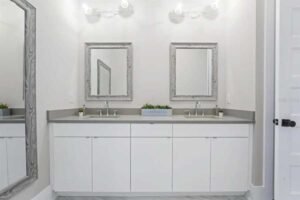
We’d rather a client buy a well-built wholesale vanity than a poorly built custom one. In our experience, the material specification matters more to long-term durability than whether the piece is one-of-a-kind. Here’s what we specify across both product lines, and why:
- Plywood boxes as our baseline, wholesale or custom. Plywood resists swelling and delamination far better than particleboard, and a bathroom vanity box sits closer to daily moisture than almost any other cabinet in the house.
- Factory-finished MDF doors. Paint holds up smoothly on MDF, while solid wood doors are more prone to swelling or cracking in a humid bathroom over time.
- Marine-grade or exterior-grade plywood for waterfront properties, walk-in showers with heavy steam, and any vanity installed near a soaking tub.
- Soft-close hinges and stainless-steel drawer glides that resist corrosion from Florida’s humidity and, for coastal properties, salt air.
We’ve pulled out enough swollen, delaminated vanity boxes from Tampa Bay bathrooms to treat plywood as the non-negotiable baseline, not an upsell, on every project we build.
Real Projects, Real Trade-Offs
A few examples from the kinds of projects we see regularly across Tampa Bay illustrate how the decision plays out in practice, without naming specific clients:
A South Tampa primary bath remodel.
An older bungalow with a narrow, oddly proportioned bathroom and plumbing that didn’t line up with any standard vanity width. A wholesale unit would have meant a filler panel eating into an already tight space. We built a custom vanity to the exact wall-to-wall measurement, with drawer storage built around the homeowner’s actual routine.
A Davis Islands powder room.
A small, highly visible half-bath where the vanity functioned as a design centerpiece. Custom sizing and a furniture-style finish made the room feel intentional rather than like an afterthought.
A multifamily development in Tampa Bay.
A 40-unit apartment project where every bathroom needed a matching, durable vanity on a tight construction schedule. Wholesale cabinetry, built on our standard plywood box, let the builder hit their timeline without sacrificing the humidity resistance the units would need long after move-in.
An investor rehab project.
A flip on a tight turnaround budget, where wholesale vanities with a clean, neutral finish gave the property an updated look without custom lead times eating into the resale timeline.
What Bathroom Vanities Typically Cost in Tampa
Pricing varies by project scope, but as a general range: wholesale bathroom vanity packages for builder and multifamily projects are typically priced per unit and scale down with volume, making them cost-effective for projects with 10 or more matching units.
Fully custom single vanities generally run higher per unit, reflecting the labor of a build to exact dimensions, but often cost less than homeowners expect when compared against retail “custom-look” vanities from big-box retailers that still use particleboard construction.
Semi-custom vanities typically fall in between, and are a common choice for full bathroom remodels where budget matters but standard sizing won’t work.
How to Decide Between Custom and Wholesale
A few questions we walk clients through during consultations:
- Is this one bathroom or many? A single primary bath usually justifies custom. Ten or more matching units usually points to wholesale.
- Does your layout match standard sizing? Older Tampa homes and non-standard plumbing often push toward custom or semi-custom by necessity, not preference.
- What’s your timeline? Wholesale orders move faster. Custom builds take longer because they’re built to order.
- How close is the vanity to heavy moisture? Walk-in showers, soaking tubs, and waterfront properties are where we most often recommend upgrading to marine-grade plywood, regardless of custom or wholesale.
- Is this an investment property or your daily-use home? Rental and resale-focused projects often make more sense with wholesale; a primary residence you’ll use for years usually earns out the cost of custom.
Common Mistakes We See
- Assuming “wholesale” always means lower-quality materials, when the real risk is particleboard construction, not the wholesale label itself
- Ordering fully custom vanities for a multifamily project where standard sizing would have worked fine and saved significant budget
- Choosing a wholesale vanity for an older home with non-standard plumbing, then paying for costly on-site modifications to make it fit
- Skipping marine-grade upgrades near showers and tubs to save a small amount upfront, then dealing with a swollen box within a few Tampa summers
- Not asking what material the cabinet box is built from, and assuming all “custom” cabinetry is automatically built to last
Our Process, From Consultation to Installation
Whether you need one custom vanity or a wholesale package for a 60-unit development, the process follows the same core steps:
- Consultation. We review your project scope, timeline, and budget, whether that’s an in-home visit for a single bathroom or a project walkthrough for a builder or property manager.
- Measurement and material selection. For custom and semi-custom projects, we take exact measurements. For wholesale orders, we confirm standard sizing and finish selections across all units.
- Photorealistic 3D rendering, typically delivered within 24 to 72 hours, so you can see the finished vanity before production starts.
- Manufacturing and installation, managed by our own team, including coordination with countertops and other finishes for full bathroom remodels.
This is the same process behind our kitchen cabinet and countertop work. The material standards and design process scale to the project, not the other way around.
Why This Decision Is Worth Getting Right
The National Kitchen & Bath Association has reported that bathroom remodels remain among the top renovation projects for return on investment, and vanity quality plays a direct role in how a bathroom is perceived by buyers and appraisers alike.
In our experience, a swollen or delaminating vanity box is one of the fastest ways a bathroom starts to look dated, regardless of how new the fixtures and tile are. Getting the box material right, whether the vanity is custom or wholesale, protects that investment far longer than the finish or hardware choice does.
Ready to Figure Out Which Option Fits Your Project?
If you’re not sure whether your bathroom project calls for custom, semi-custom, or wholesale cabinetry, that’s exactly what a consultation is for. Schedule a free consultation with IQ+ Cabinetry and you’ll get a project walkthrough, precise measurements where needed, material recommendations suited to your bathroom’s exposure to moisture.
In most cases, a photorealistic 3D rendering takes 24 to 72 hours, so you know exactly what you’re getting before production starts.
Frequently Asked Questions
Is wholesale bathroom cabinetry lower quality than custom?
Not necessarily. At IQ+ Cabinetry, both our wholesale and custom bathroom vanities are built on the same plywood-box standard. The difference is sizing flexibility and finish options, not the underlying material quality.
When does a wholesale bathroom cabinet make more sense than custom?
Wholesale typically makes more sense for builders, multifamily developments, and investor rehab projects where you need multiple matching units on a set timeline and budget. It also fits standard-sized bathrooms where a custom build wouldn’t add functional value.
When should I choose a custom bathroom vanity instead?
Custom is usually the better fit for primary bathrooms, older Tampa homes with non-standard layouts or plumbing, and waterfront properties where humidity resistance and an exact fit matter most.
Do you offer wholesale bathroom cabinets for multifamily or builder projects in Tampa Bay?
Yes. We supply wholesale cabinet packages for builders, multifamily developments, and investor rehab projects across Tampa Bay, holding to the same plywood-box construction standard as our custom residential work.
What’s the difference between semi-custom and wholesale vanities?
Semi-custom uses standard box construction with more flexibility in sizing, finish, and storage than a wholesale unit, at a price point between wholesale and fully custom.
What cabinet material lasts longest in a Tampa bathroom?
Plywood boxes with factory-finished MDF or painted doors hold up best in our experience. We recommend upgrading to marine-grade plywood for vanities near walk-in showers, soaking tubs, or in waterfront properties.